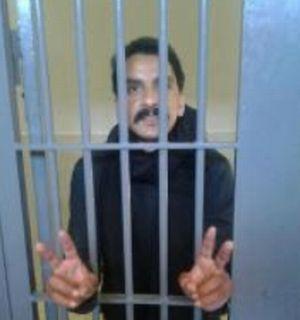
human rights defender
Mohamed Embarek Lefkir
© Front Line Defenders
human rights defender
© Front Line Defenders
(AI Translated) Immediate release of the Sahrawi political prisoner "Mohamed Mubarak Lafqir".
1978
Man
Urban
(AI Translated) Mohammed Ambarak Lfaqir, a Sahrawi human rights defender, was born in 1978. In 2017, the Court of Appeal in the city of Salé issued a judgment sentencing him to twenty‑five years in prison, stemming from the case related to the Akdim Ezik protest camp organized by the city of Laayoune, occupied, about 13 kilometres away.
Before his arrest, Mohammed Ambarak Lfaqir was an activist defending human rights and participated as part of a delegation of Sahrawi human rights defenders that discussed the human rights situation in Western Sahara. It is believed that these activities were the main reason for his targeting and arrest by the Moroccan occupation forces.
During his trial before the Court of Appeal, the Sahrawi human rights defender stated that he was kidnapped on 12 November 2010 from his uncle’s house by a group of police officers in civilian clothes who wore masks to conceal their identities. He added that he was beaten in front of his family members before being transferred to the local prison in Laayoune, known as the “Black Prison,” where he remained detained until 17 June 2011.
The Sahrawi political prisoner Mohammed Ambarak Lfaqir further said that he was temporarily released on that date, but was immediately re‑arrested after leaving the prison. He testified before the court that the police reports and confessions attributed to him were signed under torture and ill‑treatment, denying that they were given voluntarily.
Mohammed Ambarak Lfaqir also confirmed that he was present at the Akdim Ezik camp on 8 November 2010, and that during the first hours of the camp’s dismantling he lost consciousness after inhaling the tear gas used in the operation. He added that his family members carried him about four kilometres before he was able to walk another eight kilometres to his home in the occupied city of Laayoune.
The Sahrawi human rights defender Mohammed Ambarak Lfaqir undertook several hunger strikes to protest his detention conditions and deprivation of his basic rights. He participated in an open hunger strike in 2011, and later in another open strike that began on 1 March 2016 together with twelve Sahrawi political prisoners from the Akdim Ezik group, demanding recognition of their status as political detainees, the annulment of the sentences against them, their release, or at least their transfer to prisons closer to their families and the guarantee of their basic rights. This strike lasted 37 days before being temporarily suspended in response to appeals from families and several human rights organizations, after it caused a serious deterioration in the health of the strikers.
In prison (sentenced)
Nov 12, 2010
(AI Translated) A twenty‑five‑year window.
Latitude: 28.4329
Longitude: -11.0918
(AI Translated) Al‑Tantatan
(AI Translated) Local prison in Tantan
طريق بن خليل، طانطان 82000.
(AI Translated) The Sahrawi political prisoner "Mohamed Ambarek al-Faqir" suffers from medical neglect, experiencing pain in his liver and stomach and intestinal diseases.
(AI Translated) He undertook a 48‑hour hunger strike on 16 and 17 June 2026.
(AI Translated) https://spcommreports.ohchr.org/TMResultsBase/DownLoadPublicCommunicationFile?gId=23226
https://docs.un.org/A/HRC/WGAD/2023/23
https://www.amnesty.org/en/documents/mde29/3721/2016/en/
Documented by