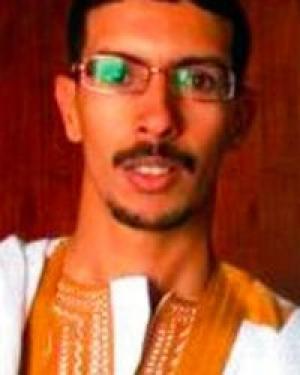
human rights defender
Ahmed Sbaai
© Front Line Defenders
human rights defender
© Front Line Defenders
(AI Translated) Call for the immediate release of the Sahrawi political prisoner Ahmed Al-Subaie.
1978
Man
Urban
(AI Translated) Ahmed al-Sabbai, a Sahrawi human rights defender born in 1978, is currently serving a life imprisonment sentence after the Court of Appeal in Salé issued a conviction in 2017 in the case related to the events at the Akrim Ezik camp.
The Sahrawi political prisoner Ahmed al-Sabbai is known as the honorary president of the Sahrawi Association for the Protection of Political Prisoners inside Moroccan prisons, an organization that aims to defend the rights of Sahrawi political detainees and monitor their conditions in detention. Because of his human‑rights activism, he was arrested and imprisoned in 2002 and 2006, and was re‑arrested following the Akrim Ezik events.
During his trial before the Court of Appeal, Ahmed al‑Sabbai reported that he was arrested on 8 December 2010 while attending a family gathering in the Lirak neighborhood of Laâyoune, the occupied city. He explained that after his arrest he was subjected to torture and intimidation during interrogation, and remained blindfolded and hand‑cuffed until his transfer to the military court in Rabat.
The Sahrawi political prisoner also affirmed before the court that the confessions attributed to him were extracted under torture and ill‑treatment, and were later used as the main evidence for his conviction, despite his denial of their content and his request that they be excluded.
Human‑rights activist Ahmed al‑Sabbai was present at the Akrim Ezik camp on 8 November 2010, where he testified before the court about the dismantling of the camp, describing the violent intervention the camp and its inhabitants suffered during the operation.
The Sahrawi human‑rights defender Ahmed al‑Sabbai has undertaken several warning hunger strikes in Moroccan prisons, protesting what he described as continuous medical neglect, denial of necessary treatment and health care, and being prevented from being transferred to a hospital for examinations and treatment. He also used the hunger strike to protest what he considered arbitrary and discriminatory practices against him, including restrictions on his fundamental rights such as the obstruction of receiving parcels sent by his family. During 2023 and 2024 he carried out a number of warning hunger strikes lasting between 24 and 48 hours, demanding respect for his rights guaranteed under international human‑rights law and the United Nations Standard Minimum Rules for the Treatment of Prisoners (the Nelson Mandela Rules), and ensuring his right to treatment and health care without discrimination.
In prison (sentenced)
Dec 8, 2010
Latitude: 34.27374
Longitude: -6.59349
(AI Translated) Kenitra
(AI Translated) Kenitra Central Prison
Maison Centrale de Kénitra, Route de Mehdia, Kénitra, Morocco
(AI Translated) The Sahrawi political prisoner Ahmed Al-Subaii suffers from medical neglect, experiencing visual impairment, and the prison administration under the Moroccan occupying authority has refused to transfer him for hospital treatment for five years.
(AI Translated) He/She undertook a warning hunger strike on 30 June and 1 July 2026.
(AI Translated) https://spcommreports.ohchr.org/TMResultsBase/DownLoadPublicCommunicationFile?gId=23226
https://docs.un.org/A/HRC/WGAD/2023/23
https://www.amnesty.org/en/documents/mde29/3721/2016/en/
Documented by